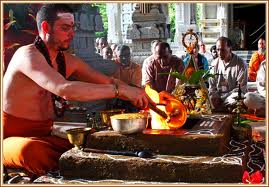
Puja means
worship,devotion and reverence. Puja is believed to be derived
from the word 'pu-chey',or worship. The term puja is now used to
include all forms of worship, ranging from the simple daily
offerings of flowers, fruit, leaves, rice, sweetmeats and water to
the deities in homes or temples, to the sacrifices in temples
dedicated to Kali, Durga and other female deities.
There are three kinds of pujas: "Dhirdha",
"Madhya" & "Laghu". Puja ritual of idols
of God has become in recent times a great of faith and belief in
Hindu Religion. Puja is not only performed in temples but also
in most of our homes. we worship God in our meetings before we
start our days' programme of Jagran/Bhajan/Kirtans/ Ramayana and
/or study of scriptures. The object of the puja ritual is to
create and setup thoughts of spiritual forces in and around us.
This is best achieved by chanting of some Mantra ,Bhajan
or Chalisas, The benefit of puja is to remove obstacles.
The pujas are performed on behalf of those who request them by
us. Some of the benefits for doing specific pujas include:
Obtaining happiness and peace by getting rid of
malefic forces. Removing troubles that prevent us from starting
on a spiritual path or business Gaining material spiritual,
prosperity and abundance. Creating positive vibrations in
the house, when starting new ventures such as a new job,business.
Removing obstacles if suffering from losses, when starting a new
business or investments. Improving the general health of body
and mind, for a speedy recovery from illness. Increasing
leadership skills. We can enhance the benefit of the Puja by
doing spiritual practices. Some of the commonly observed
practices include Meditation, Mantra Japa , Silence, Prayer,
Fasting or Repeating God's name, charity. These vows can be done
for one day or as long as you wish. The result of these actions
is to enable us to imbibe more deeply the spiritual energy
invoked by the Puja and to help purify us. We perform Puja with
video support and Puja DVD along with other Puja items
are shipped.
Available Pujas/Homam/Jaap for Love Marriage
Maha Mrityunjaya Pooja & Homam for Health
Maa Katyayni Puja & Yagna (Fulfills
the desire of marriage for a ‘female’)
Chandi Yagna (Fulfills
the desire of marriage for a ‘male’)
Durga Yagna (Fulfills
the desire of marriage for a ‘male’)
Santaan Gopal Yagna (Fulfills
the desire for child/progeny bliss)
Lakshmi Yagna (Wealth
Enhancement)
Kuber Puja & Yagna (Wealth
& Riches)
Kali Puja & Yagna (Protection
from’ Black Magic’)
Lord Hanuman Yagna (Bestows
divine grace and Protects from enemies & evil spirits)
Maha Mrityunjaya Puja
& Yagna (Evade
death/sickness and gain good health)
Goddess Bagla Mukhi Puja
& Yagna (To
destroy the enemy in dispute and gain power & victory)
Shat Chandi Path (Makes
any impossible task possible)
Lord Vishnu Yagna(Ultimate divine grace, wealth,
prosperity, joy, spiritual bliss)
Kal Sarpa Shanti Puja
& Yagna (Dilutes
the ‘Kaal Sarpa Yoga’/Serpent Curse in a horoscope)
Nav Graha Puja &
Yagna (Propitiates
all the nine planets in a horoscope).